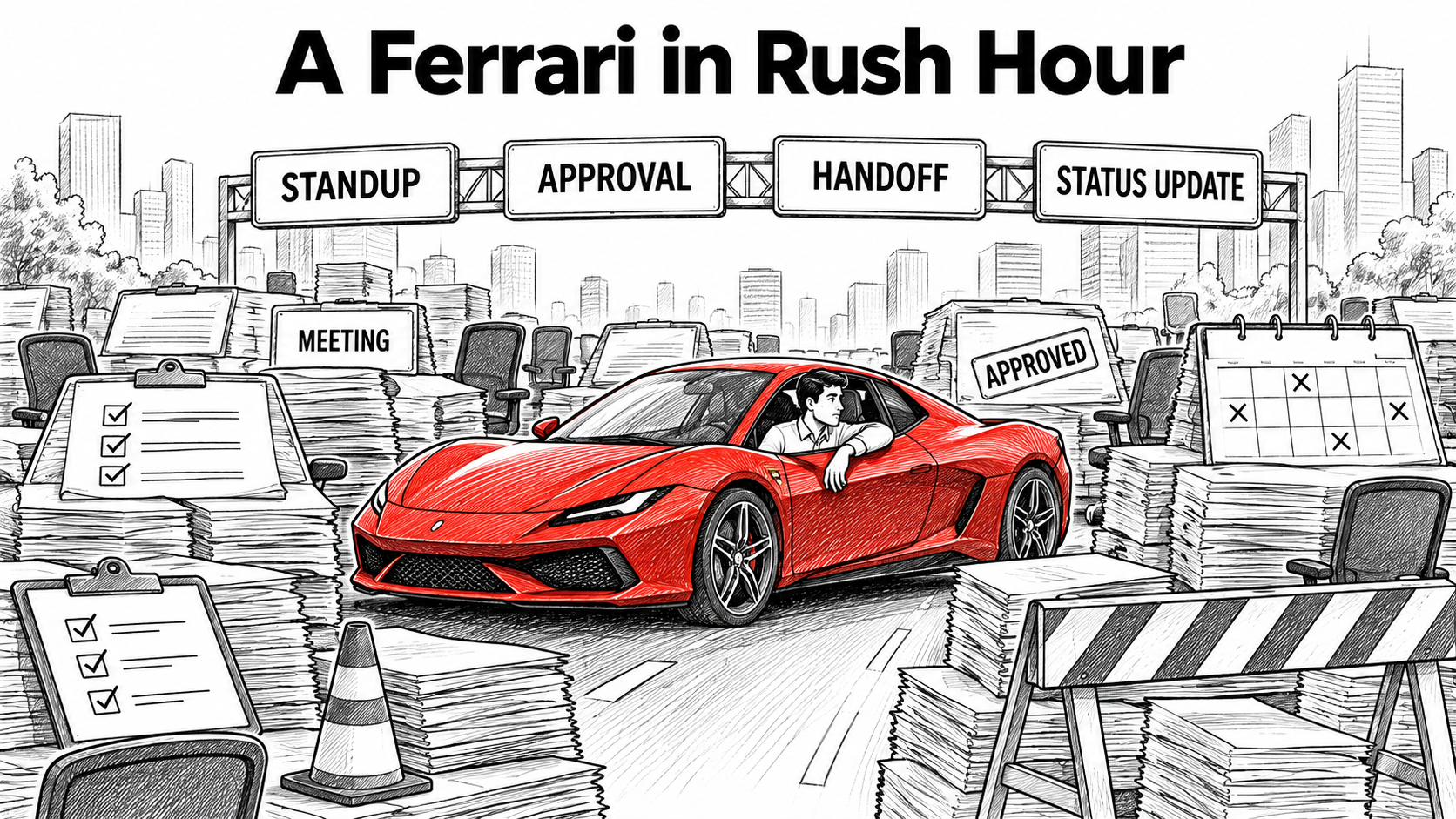
A Ferrari in Rush Hour: Why AI Needs a New Way of Working, Not Just New Tools
AI made doing the work cheap, but our process is still built for humans coordinating humans. What I'd change: teams sized to the mess, a shared foundation, clear lines from leadership, and testing that never stops.
8 min read
- AI Operating Model
- Agile
- AI Strategy
- Engineering Leadership
- AI Governance
I am writing this for myself, and for any leader who rolled out AI tools to their teams, waited a quarter, and wondered why the roadmap still moves at the same speed.
Picture a typical sprint planning meeting. Twelve people, two hours, a backlog on the screen, and a long debate about whether a story is a five or an eight. Meanwhile, the engineer in the corner has already built a working version of that story with a coding agent before lunch.
That gap stayed with me. The work changed. The meeting didn't.
The Calendar Didn't Get the Memo
Agile deserves a lot of credit. It is what made cross-team work bearable. It gave product, engineering, QA, security and ops a shared rhythm. That was the real problem back then: not typing code, but getting a room full of specialists to move in the same direction.
But Agile carried a hidden assumption. Humans did the execution. Every ritual, every handoff, every status update was designed around people being the slowest, most expensive part of the system.
Today an AI session can write the code, the tests and the docs, and fix its own mistakes, often in one sitting. So effort is not the bottleneck anymore. The bottleneck is everything we stacked around effort to keep humans in sync.
Put AI inside that old stack and you get what I call a Ferrari in rush hour. Plenty of horsepower. Nowhere to go.
Insight: When execution gets cheap, coordination becomes the most expensive thing you own.
Build Teams Around Results, Then Size Them Honestly
The first change is the shape of the team. Instead of teams organized around a function or a ritual, I think in terms of small units that own a result. Call it an outcome pod. It owns one business outcome, the part of the system it may touch, the tools it may use, and the risk it may take.
Here is where I disagree with a lot of the AI hype. Smaller is not automatically better.
Think about food. A food truck with two people can run a tight menu beautifully. Fast, focused, no wasted motion. But you would never ask that same crew to cater a three-hundred-person wedding with dietary restrictions, a fixed timeline and a nervous family. That needs a full kitchen brigade, and nobody calls the brigade bloated.
Software is the same.
Food-truck pods, one to three people. A narrow feature, an internal tool, an automation, a support flow. Here one person with a coding agent can genuinely go from idea to shipped and tested, with no relay race of handoffs in between.
Brigade pods, five to eight or more. SAP modernization, unwinding a mainframe, a regulated workflow, a migration that touches ten other systems. The difficulty here is not speed. It is all the history, dependencies and edge cases buried in the system. A tiny pod on that work does not look lean. It looks stuck.
So when an executive asks me, "Should all our teams get smaller?", I gently push back. The better question is, "How tangled is the thing we are changing?" Match the crew to the job.
And whatever the size, a pod should start from shared building blocks, not from scratch. The moment every pod invents its own prompts, its own access rules and its own workarounds, the freedom you thought you created turns into drift.
Insight: Team size is not a culture choice. It is a reading of how messy the system is.
The Boring Layer That Makes Speed Safe
Everyone loves talking about the pods because pods ship things you can demo. The layer I care about more is the one underneath. I call it the harness.
Think of an airport. Airlines compete on speed, routes and service. But none of them builds its own runway, its own air traffic control or its own security line. Those are shared, strict and pretty boring. And that boring layer is exactly why hundreds of planes can move fast without crashing into each other.
The harness is the airport for your AI work. It holds the things every pod needs but no pod should reinvent:
approved patterns for prompts and workflows
who and what can access which tools and data
architecture guardrails
how work gets tested and evaluated
policy checks, logging and audit trails
how to roll back when something goes wrong
There is a performance reason for this too, not just a governance one. Models do worse when you flood them with context they don't need or hand them a toolbox of fifty tools for a three-tool job. A good harness gives each workflow only what it needs, records evidence as the work happens, and stops unsafe actions before they start.
Skip it, and every pod quietly builds its own little AI stack. It feels fast for a few months. Then one day someone asks, "Which agents can touch customer data?" and nobody in the room can answer.
Insight: The fastest teams are usually not the ones with the most freedom. They are the ones with the best shared runways.
Somebody Has to Draw the Lines
Pods move. The harness enforces. But someone has to decide what the rules actually are. That is leadership's job, and I call it the strategic layer.
This used to matter less because AI mostly answered questions. Now it takes actions. It calls tools, triggers workflows and works across departments. Without clear lines from the top, each function writes its own rulebook. Finance has one view of risk, support another, product a third. Each choice is smart on its own. Together they make no sense.
The questions leadership has to answer plainly are not technical:
Where are we comfortable letting AI act on its own?
Which systems are look-but-don't-touch?
Which actions always need a human to say yes?
Where will we trade a little certainty for speed, and where never?
Once those answers exist, the flow is clean. Leaders decide the rules. The harness turns them into code. Pods do their work inside them.
Insight: If leaders don't draw the lines, every team will draw its own, and none of them will match.
When AI Can Act, the Risk Lives in the Permissions
When enterprises first started worrying about AI, the fears were about words. Made-up facts, bad tone, leaked prompts. Those still matter, but they are no longer the biggest risk.
Once AI can act, the real questions are: What was it allowed to do? What did it actually do? And can we trace every step afterward?
I like the valet key as an analogy. When you hand your car to a valet, you give them a key that starts the engine and opens the door, but not the trunk or the glove box. The valet is trusted, just not for everything. A lot of AI setups today hand over the full key ring because nobody took the time to cut a valet key.
Security people call one version of this the "confused deputy" problem. An agent that is legitimately allowed to do one thing gets talked into doing something next to it that it should not. Think of an assistant that combines records it was never meant to combine, or a workflow agent that kicks off an action the person who asked for it was never allowed to take.
That is why I now believe permission design is operating model design. If you can't list your agents, what each one can reach and what each one can do, you are not governing AI. You are hoping.
Insight: The real AI risk is not what it says. It is what it is allowed to do.
Build It and Attack It at the Same Time
Traditional testing works like a relay. Build, hand it to QA, get bugs back, fix, repeat. That rhythm is far too slow when AI is producing changes all day, and far too weak when those changes can take real actions.
What I prefer is closer to a boxer and a sparring partner. One group of agents builds, fixes and documents. Another group's only job is to hit back: hunting for leaked secrets, over-broad access, agents doing things they shouldn't, weak fallbacks, and failures that look fine until they are not.
Both work inside the same harness, so everything they find is recorded the same way. Nothing gets saved for a big checkpoint at the end. The system is being challenged the whole time it is being built.
Insight: Quality is not a gate at the end anymore. It is a sparring match that never stops.
Every Era Bets on What Is Scarce
When I step back, I see a pattern. Waterfall made sense when rework was painful, so it bet on stability. Agile made sense when coordinating many specialists was the hard part, so it bet on coordination. Now that producing work is getting cheaper every month, the bet shifts to leverage.
What is scarce now is not effort. It is good judgment, clean context, thoughtful permissions, clear boundaries, and the ability to handle exceptions well. Those are the things worth organizing around.
Insight: Every operating model is really a bet on what's scarce. The scarce thing just changed.
What I Would Keep, and What I Would Let Go
People sometimes hear this and think I am saying Agile is dead. I am not.
I would keep short feedback loops, clear priorities and the habit of learning fast. Those are timeless. What I would let go of is the ceremony that grew around human throughput: marathon grooming sessions, estimation debates, status meetings that exist so someone can repeat a dashboard out loud, and approval chains with more layers than the work itself.
I also know this is not just a process change. For many people, those rituals are where their role and their authority live. That makes this emotional, and a bit political. My approach is to remove things carefully. Keep whatever helps us make better decisions. Remove whatever mostly records delay.
And if I had to pick one place to start, it would be the foundation, not the teams. Fast pods on top of ad hoc prompts and unmanaged access will look amazing in a demo and fall apart at scale. A solid harness is what turns a few impressive wins into a way of working.
Insight: Keep the habits that improve decisions. Let go of the rituals that only document delay.
Where That Leaves Us
For a long time, leading meant helping people coordinate. Right people, right room, right order. That still matters, but it is no longer the center of the job.
The center now is deciding what is worth building, being clear about what machines may and may not do, and building the shared foundation that lets small teams move fast without putting the company at risk. That means redesigning how teams work almost from a blank page, and I find that genuinely exciting.
Insight: Agile taught us how to work together. AI is asking us to design for leverage instead.
To self and to curious folks out there, question the process, keep what works, and have fun.
2 views
Respond
Select a passage if you want it included. Your email is never shown. I read each response before it appears here.